Solutions overview
 Account take over (ATO)
 Digital Impersonation
 Credit card data theft
 Man in the Middle (MitM)
 Remote desktop takeover
 Credential stuffing
 SEO poisoning
 For security teams
 For fraud/risk teams
 For digital business teams
 Library
 Blog
Blog Glossary
 Partner Up
 About
About News
News Events
 Careers
 Contacts
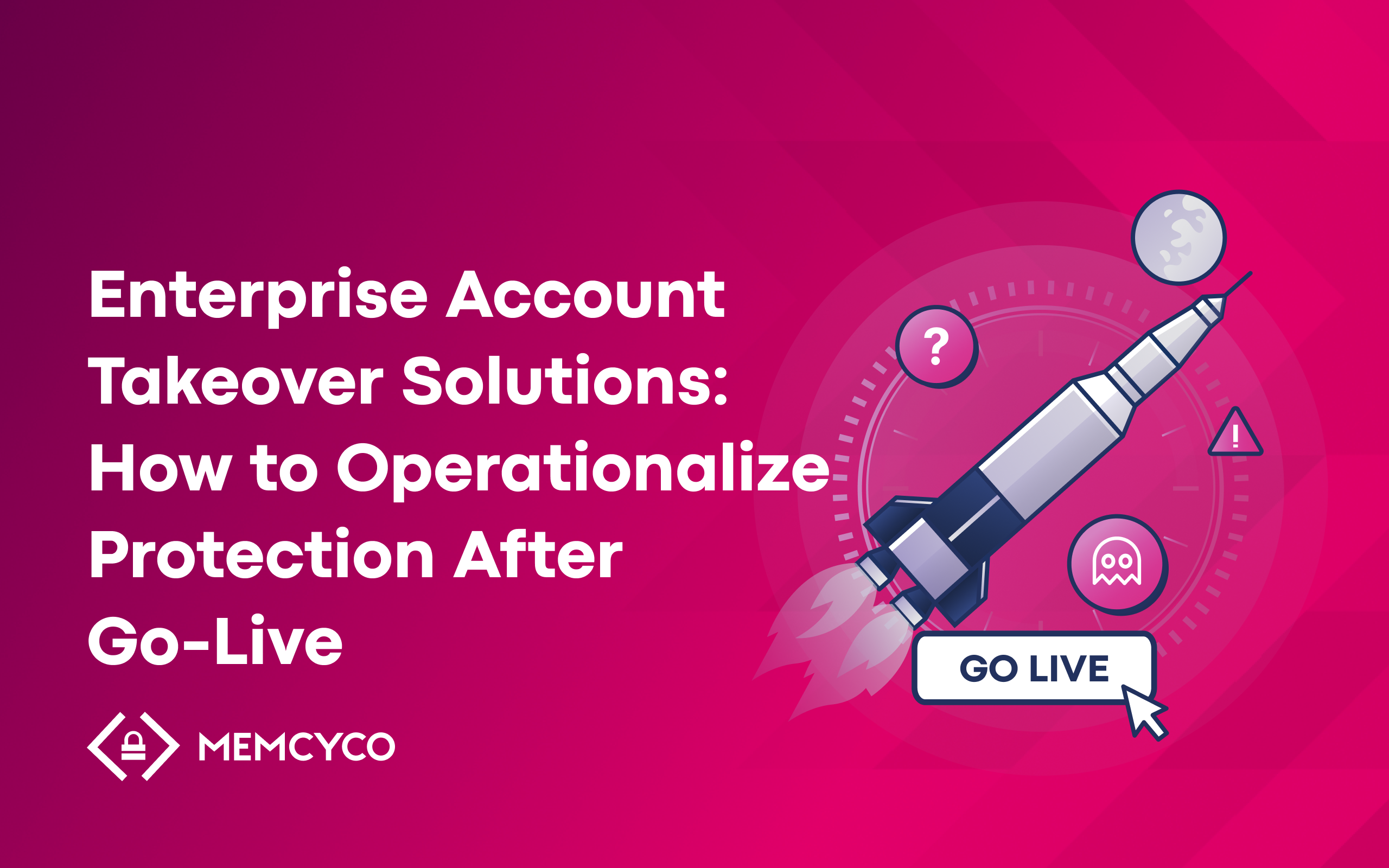
Enterprise account takeover solutions often look strong during procurement.
The real test begins after go-live.
Integration completes. Alerts begin flowing. Fraud, SOC, and digital leaders see new data. Now the question shifts from deployment to operationalization.
How do enterprises turn early ATO visibility into measurable fraud reduction, faster investigations, and stronger regulatory posture?
This guide explains how to operationalize modern enterprise-grade account takeover (ATO) after go-live, based on frontline enterprise deployment insights .
Executive takeaways for enterprise leaders
ATO protection fails when it remains a technical integration rather than an operational shift.
Four realities define successful post-go-live execution:
- Agentless deployment compresses time to value from months to days
- The first 30 days determine long-term maturity
- Alert tuning and ownership alignment prevent internal bottlenecks
- Near-zero mean time to detection transforms fraud response from reactive to preemptive
Enterprises that operationalize correctly move from investigating fraud to preventing it.
Why go-live is not the finish line
Traditional agent-based security tools require endpoint rollout, compatibility testing, staged releases, and change control processes. In large environments, that takes months.
Memcyco’s PoSA – Proof of Source Authenticity operates in an agentless model. Deployment typically includes:
- Lightweight code snippets added to customer-facing assets
- API integrations enriching anti-fraud and SIEM systems
- DNS configurations for resilience
- Centralized dashboard configuration
Go-live is measured in days, not quarters .
But fast deployment does not automatically equal operational impact.
The real work begins once upstream exposure data starts flowing.
The first 30 days: operational friction points
Most enterprises encounter three predictable bottlenecks.
Alert volume surge
When upstream visibility activates, teams begin seeing exposure signals before authentication misuse.
Fraud analysts and SOC teams receive:
- Victim exposure alerts
- Campaign correlation data
- Device DNA signals
- Credential harvesting indicators
For many fraud and risk teams, this represents a structural shift from post-login anomaly review to exposure-based prioritization.
Without defined ownership and routing, alert fatigue follows.
Signal tuning and false positive management
Early visibility surfaces edge cases:
- Affiliate and partner traffic
- Legitimate redirects
- Cross-border campaign behavior
Detection sensitivity must be calibrated. Enforcement should not be immediate. Mature deployments collect data, fine-tune risk thresholds, and gradually introduce adaptive controls.
Fine-tuning is not weakness. It is operational discipline .
Ownership ambiguity
ATO sits between teams:
- Fraud measures financial impact
- SOC classifies security incidents
- Digital leaders protect customer experience
- Compliance monitors regulatory exposure
Operational maturity requires:
- A defined primary owner
- Shared KPIs
- Clear SLAs
- Predefined remediation playbooks
Without this structure, visibility does not translate into action.
From reactive detection to exposure prioritization
The largest enterprise blind spot is assuming compromise begins at authentication.
It does not.
Modern attacks begin upstream:
- Brand impersonation infrastructure
- Phishing page cloning
- SSL certificate registration
- Credential harvesting
- Session replay preparation
- Man-in-the-Middle (MitM) attacks that bypass MFA
If controls activate only at login, the organization is already inside the attacker’s monetization window .
Enterprises must gain visibility into digital impersonation campaigns before credentials are reused.
Operationally, this changes fraud investigation entirely.
Instead of stitching together login logs, threat intelligence feeds, device history, and phishing reports, analysts receive unified, correlated incidents with risk scoring and full campaign timelines.
Investigation time can be reduced by up to 90% .
Infiltrating live attacks vs. scan-and-takedown
Scan-and-takedown models remain reactive and infrastructure-focused.
They detect a malicious domain. They validate abuse. They request removal. The process can take days.
Attackers monetize within hours.
Modern fraud operations include:
- credential stuffing against harvested accounts
- Search manipulation techniques such as SEO poisoning
- Impersonation-driven payment diversion
- Loyalty and credit card scams
Infiltrating live attacks changes the operating model.
When credential harvesting occurs:
- Real credentials are swapped with decoy data
- Attacker workflows are disrupted
- Devices are tagged
- Campaign infrastructure is correlated
Instead of waiting for domain removal, enterprises neutralize stolen data at capture .
Near-zero mean time to detection as a KPI
Mean time to detection is a financial control metric.
In phishing-driven ATO, monetization happens quickly. The longer detection takes, the greater the exposure window.
Near-zero detection time is achievable only when visibility begins before login misuse .
Enterprises should track:
- Time from impersonation campaign creation to detection
- Time from exposure to analyst alert
- Time from alert to remediation
- Percentage of incidents neutralized pre-login
These KPIs define operational maturity.
Regulatory posture and duty of care
Financial institutions are not evaluated solely on reimbursement rates.
Regulators evaluate prevention effectiveness.
Preemptive ATO protection strengthens regulatory posture by demonstrating:
- Early detection of impersonation infrastructure
- Identification of exposed users
- Disruption of stolen credentials at capture
- Correlated incident documentation
This evidence supports duty-of-care requirements and proactive risk mitigation .
For security teams, this reduces incident backlog.
For digital business teams, it protects customer trust without adding friction.
Measuring ROI after go-live
Enterprise ROI is measurable across four dimensions:
- Direct OPEX reduction from investigation time savings
- Fraud loss prevention through preemptive disruption
- Regulatory risk reduction
- Brand and customer trust preservation
Organizations routinely target 10× ROI within the first year when exposure detection shifts upstream .
Reactive systems investigate fraud after compromise.
Preemptive systems prevent compromise before monetization.
The bottom line
Deploying an ATO solution is straightforward.
Operationalizing it requires:
- Clear ownership
- Cross-team coordination
- Alert tuning discipline
- KPI-driven governance
Enterprises that execute this transition move from reimbursement cycles to fraud avoidance.
That difference defines modern enterprise account takeover protection.
Frequently asked questions
1. How long does it take to operationalize an enterprise ATO solution after go-live?
Initial deployment can take days in an agentless model. Operational maturity typically stabilizes within the first 30 days, depending on alert tuning and cross-team alignment .
2. Does preemptive ATO protection increase customer friction?
No. Mature deployments begin in monitoring mode, collect ecosystem data, and introduce adaptive enforcement gradually. Legitimate users experience no added friction.
3. How does early-stage exposure visibility improve investigation efficiency?
Instead of reconstructing incidents across multiple tools, analysts receive unified, correlated campaign timelines. Investigation time can be reduced by up to 90% .
4. How does this approach differ from MFA or post-login behavioral analytics?
MFA and behavioral tools operate at authentication. They can be bypassed using Man-in-the-Middle techniques. Preemptive ATO protection detects impersonation and credential harvesting before login attempts occur.
5. Which teams benefit most from operationalizing enterprise ATO solutions?
Fraud, SOC, and digital leaders all benefit. Enterprises typically see the strongest operational gains when fraud and risk teams, security teams, and digital business stakeholders share ownership of exposure-driven KPIs.

Digital Impersonation Fraud Specialist